What Is EDC Software and Why Do Research Teams Need It?
Electronic data capture (EDC) software replaces paper-based case report forms with digital systems that collect, validate, and store clinical trial data. Every phase of a clinical study — from screening and enrollment to adverse-event tracking and database lock — generates data that must be accurate, auditable, and compliant with regulatory standards such as 21 CFR Part 11 and ICH E6(R2) Good Clinical Practice.
Without a modern EDC system, research teams face manual transcription errors, slow query resolution cycles, and audit findings that delay submissions. Sites spend hours re-entering data from paper into spreadsheets, monitors cannot verify source data remotely, and sponsors lack real-time visibility into enrollment and data quality. EDC software eliminates these bottlenecks by providing a single, validated platform where every keystroke is captured, every correction is audit-trailed, and every signature meets regulatory requirements.
The challenge is that most legacy EDC platforms were designed in the early 2000s. They require dedicated programmers to build forms, weeks of user-acceptance testing for each protocol amendment, and expensive per-seat licensing that prices out smaller sponsors and academic medical centers. AccuraTrials was built from the ground up to solve those problems.
How AccuraTrials Differs from Legacy EDC Systems
Legacy EDC platforms treat form building as a programming task. Clinical data managers write custom scripts for edit checks, QA teams run multi-week validation cycles, and any protocol amendment triggers a cascade of rework. AccuraTrials takes a fundamentally different approach.
No Programmer Required
The AccuraTrials eCRF builder uses a visual, drag-and-drop interface with pre-built CDASH-aligned field libraries. Data managers configure forms, sections, and skip logic directly — no SAS programming, no XML scripting, no vendor dependency. Changes deploy instantly with full version control.
AI-Powered Validation Rules
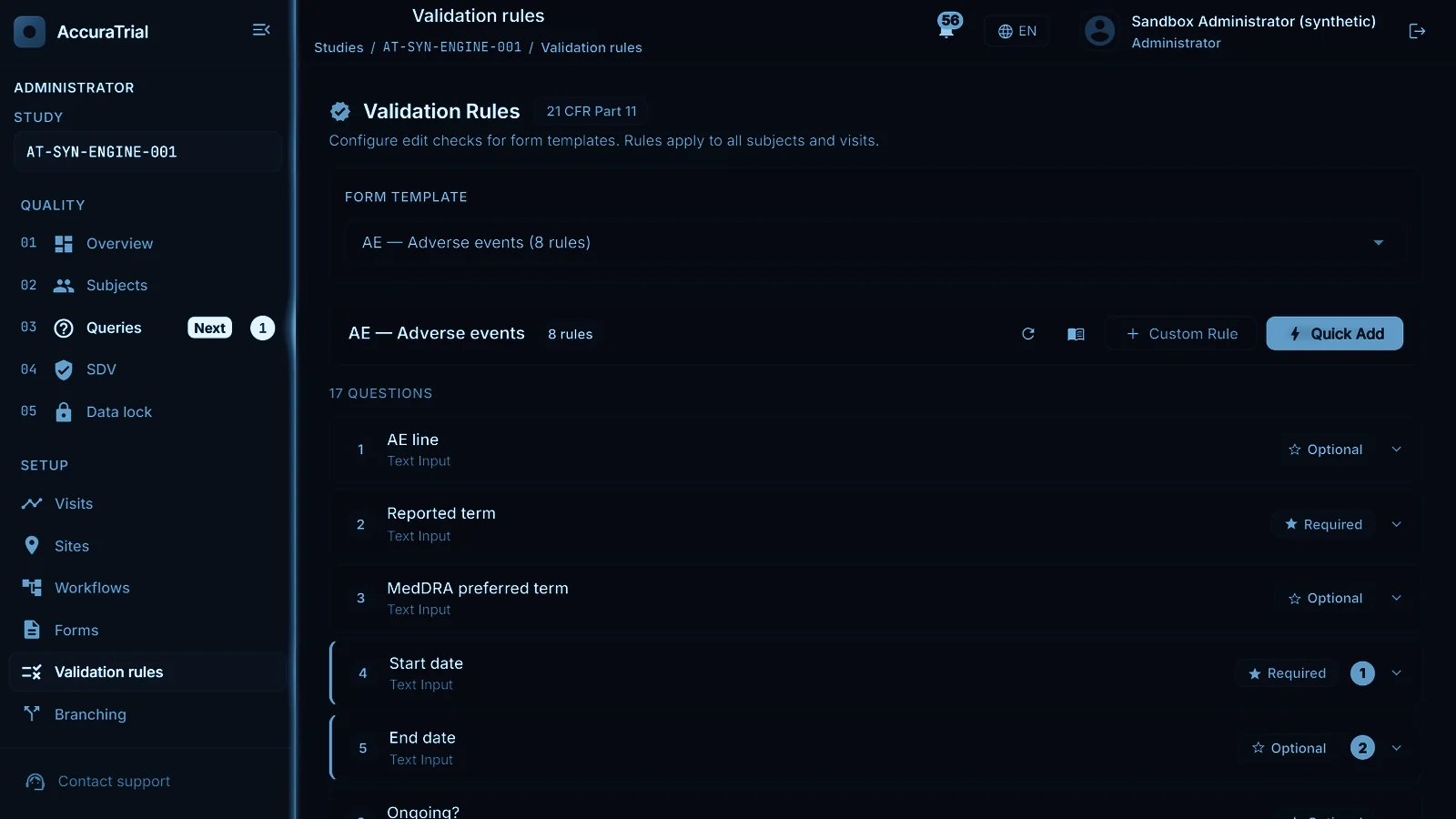
Instead of writing edit-check scripts by hand, AccuraTrials lets you describe validation requirements in plain English. The AI rule engine compiles your intent into executable validation logic, previews it against sample data, and flags edge cases before you go live. You review and approve; the system enforces. This cuts rule-authoring time from weeks to hours.
Protocol-to-eCRF in Minutes
Upload a protocol PDF and the AccuraTrials AI pipeline extracts study visits, assessments, and endpoints. It generates a complete eCRF structure — forms, fields, visit schedules, and validation rules — that you refine through a guided review. What used to take six to eight weeks of back-and-forth between medical writers and programmers now happens in a single working session.
Key EDC Capabilities
Visual eCRF Builder
Drag-and-drop form design with CDASH field libraries, section templates, conditional visibility, repeating groups, and calculated fields.
Validation Engine
AI-assisted and manual rule authoring with real-time enforcement, cross-form checks, range validation, and regex pattern matching.
Query Management
Automated and manual query workflows with role-based routing, escalation timers, bulk operations, and full resolution audit trails.
21 CFR Part 11 Audit Trails
Every data point records who changed what, when, and why. Immutable logs meet FDA regulatory requirements for electronic records.
Electronic Signatures
Username-plus-password e-signatures with reason-for-signing capture, compliant with 21 CFR Part 11 Subpart C requirements.
Data Export & Integration
Export to CSV, SAS, and CDISC-compatible formats. API-first architecture supports integration with CTMS, RTSM, and safety databases.
How Study Setup Works: Days, Not Months
AccuraTrials replaces the traditional multi-month EDC build cycle with an eight-tab study-creation wizard that walks you through every decision:
- Study Details — Name, phase, therapeutic area, and protocol identifiers.
- Sites & Investigators — Add sites, assign principal investigators, and configure site-level permissions.
- Visit Schedule — Define visits, windows, and ordering with drag-and-drop timeline editing.
- eCRF Forms — Build or import forms, assign them to visits, and configure form-level properties.
- Validation Rules — Author rules via AI or manually, preview against sample data, and activate.
- Randomization — Configure treatment arms, stratification factors, and block sizes.
- Roles & Permissions — Assign study-specific roles with granular access control.
- Review & Go-Live — Final checklist, compliance verification, and one-click activation.
Teams that previously spent eight to twelve weeks on EDC setup routinely go live in three to five business days with AccuraTrials. That speed advantage compounds across multi-site studies and protocol amendments.
Legacy EDC vs. AccuraTrials: A Direct Comparison
| Capability | Legacy EDC | AccuraTrials |
|---|---|---|
| Form building | Requires programmer | Visual drag-and-drop, no code |
| Validation rules | Custom scripts, weeks to author | AI-generated from plain English, hours |
| Study setup time | 8–12 weeks | 3–5 business days |
| Protocol amendments | Re-programming cycle | Visual edit with version control |
| Query resolution | Manual email-based workflows | Integrated query dashboard with routing |
| Audit trail | Basic logging | Immutable, field-level, 21 CFR Part 11 |
| Pricing model | Per-seat + setup fees | Transparent, usage-based |
See the Platform in Action
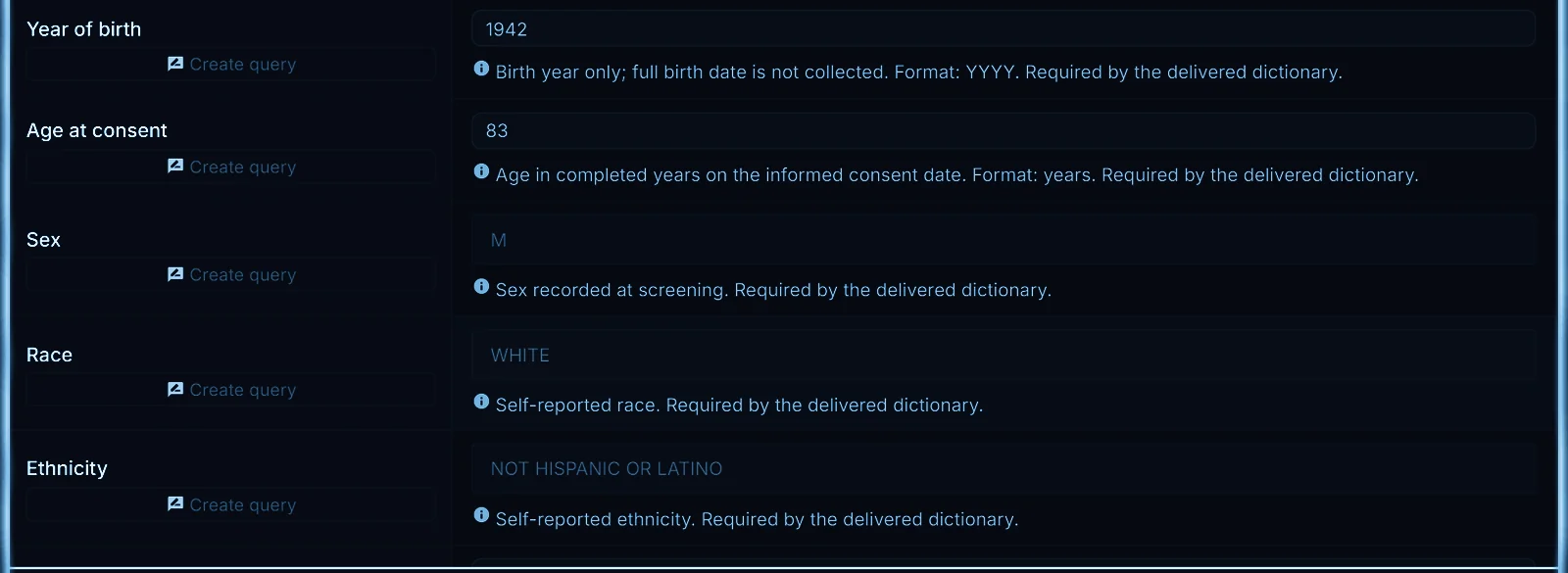
The AccuraTrials dashboard gives clinical data managers a real-time view of enrollment progress, open queries, overdue forms, and site performance metrics — all in a single screen. Visit the product page for a full walkthrough of the eCRF builder, validation rule configuration, and query management interfaces.
Frequently Asked Questions About EDC Software
What does EDC stand for in clinical trials?
EDC stands for electronic data capture. It refers to the digital systems used to collect, validate, store, and export clinical trial data. EDC software replaces paper case report forms and provides real-time data access, automated validation, and regulatory-compliant audit trails.
Is AccuraTrials EDC software 21 CFR Part 11 compliant?
Yes. AccuraTrials is designed for 21 CFR Part 11 compliance with immutable audit trails, electronic signatures, access controls, session management, and data integrity safeguards built into every layer of the platform.
How long does it take to set up a study in AccuraTrials?
Most studies go live in three to five business days. The eight-tab study-creation wizard and AI-powered eCRF generation eliminate the weeks of programming and UAT that legacy EDC platforms require.
Can AccuraTrials handle multi-site, multi-country trials?
Yes. AccuraTrials supports multi-site configurations with site-level permissions, role-based access control, and configurable visit schedules. The platform is designed to scale from single-site investigator-initiated trials to large multi-national studies.
What data formats does AccuraTrials export?
AccuraTrials exports data in CSV, SAS transport, and CDISC-compatible formats. The API-first architecture also supports direct integrations with CTMS, RTSM, safety databases, and EHR systems.
Ready to See Modern EDC Software in Action?
Schedule a live demo and see how AccuraTrials can cut your study build time from months to days — without sacrificing compliance or data quality.
Request a Demo