Study intelligence. Human authority.

The intelligence layer for clinical trials

One study ontology connects your documents, decisions and data. AI drafts the work. Your team approves.

The semantic layer

One study ontology. Built to connect the whole trial.

Every visit, form, rule and decision has one definition, linked to its source and everything it touches. One shared model for people, systems and AI.

  1. 01 · Today

    Your study lives in pieces.

    Documents, spec sheets, inbox threads and a separate copy in every system, kept in step by hand.

  2. 02 · Read once

    Each piece becomes one linked definition.

    Visits, forms, rules, lab tests and decisions become typed entities, each tied to the clause, record or signature it came from.

  3. 03 · Change once

    A change knows what it touches.

    Widen a visit window and the layer counts every form, check and value behind it before anyone signs. Nothing is retyped or rebuilt.

What it reads

Every document, decision and data point

Study documents, the decisions behind them and the data itself, read once and never retyped. The panel shows what is live today.

What runs on it

One layer under every system

Forms, checks and AI agents read the definition your team approved, and move with it when the trial changes.

  • EDC LIVE
  • CTMS
  • eTMF
  • CENTRAL LABS
  • IRT / RTSM
  • SAFETY / PV

What connects

Your systems, on the same study

AccuraTrials EDC runs on the layer today, with randomization, ePRO and eConsent built in. Connectors to central labs, eTMF, CTMS and safety systems are in development.

Standard meaning, built in

Built on CDISC USDM and OpenStudyBuilder. Every entity carries a standard definition, so your study means the same thing to every system that reads it.

  • CDISCUSDM · CDASH · SDTM
  • OpenStudyBuilderStudy definitions
  • ICH M11Structured protocol
  • TransCelerateDigital Data Flow
  • MedDRAAdverse events
  • WHODrugMedications
  • LOINCLab tests
  • SNOMED CTClinical terms
  • CDISC ODMData exchange

When the study changes

Your study will change.Nothing gets rebuilt.

Arms open and stop, amendments land, forms gain a field. Each change is applied to the running study and signed, and the data already collected stays where it is.

01 · When an arm is added

A new arm is an amendment, not a new build.

Its visits, forms and checks arrive as a reviewed change to the running study, counted before anyone signs. Participants already enrolled keep their study as it was.

Amendment review and apply built into AccuraTrials EDC
02 · When an arm stops or graduates

Arm decisions with a second signature.

Proposed, reviewed by a different qualified person, then e-signed. Only new assignments change, and arm names stay out of the general audit view to protect the blind.

Governed arm decisions built into AccuraTrials EDC

03 · When a form needs a field

Every patient’s copy, brought current in place.

Existing patient forms update where they are, with values, queries and locks untouched and every copy audited. A signed form changes only if you opt in, with the reason recorded.

Form propagation built into AccuraTrials EDC

04 · When the data disagrees

Differences become decisions, not a cleanup sprint.

Adverse events are matched to safety reports case by case, each discrepancy verified by a second investigator. Kit counts and imports are reconciled against their source, and open safety items hold closeout.

Safety, supply and import reconciliation built into AccuraTrials EDC

AccuraTrials EDC

In production today,on a paid study.

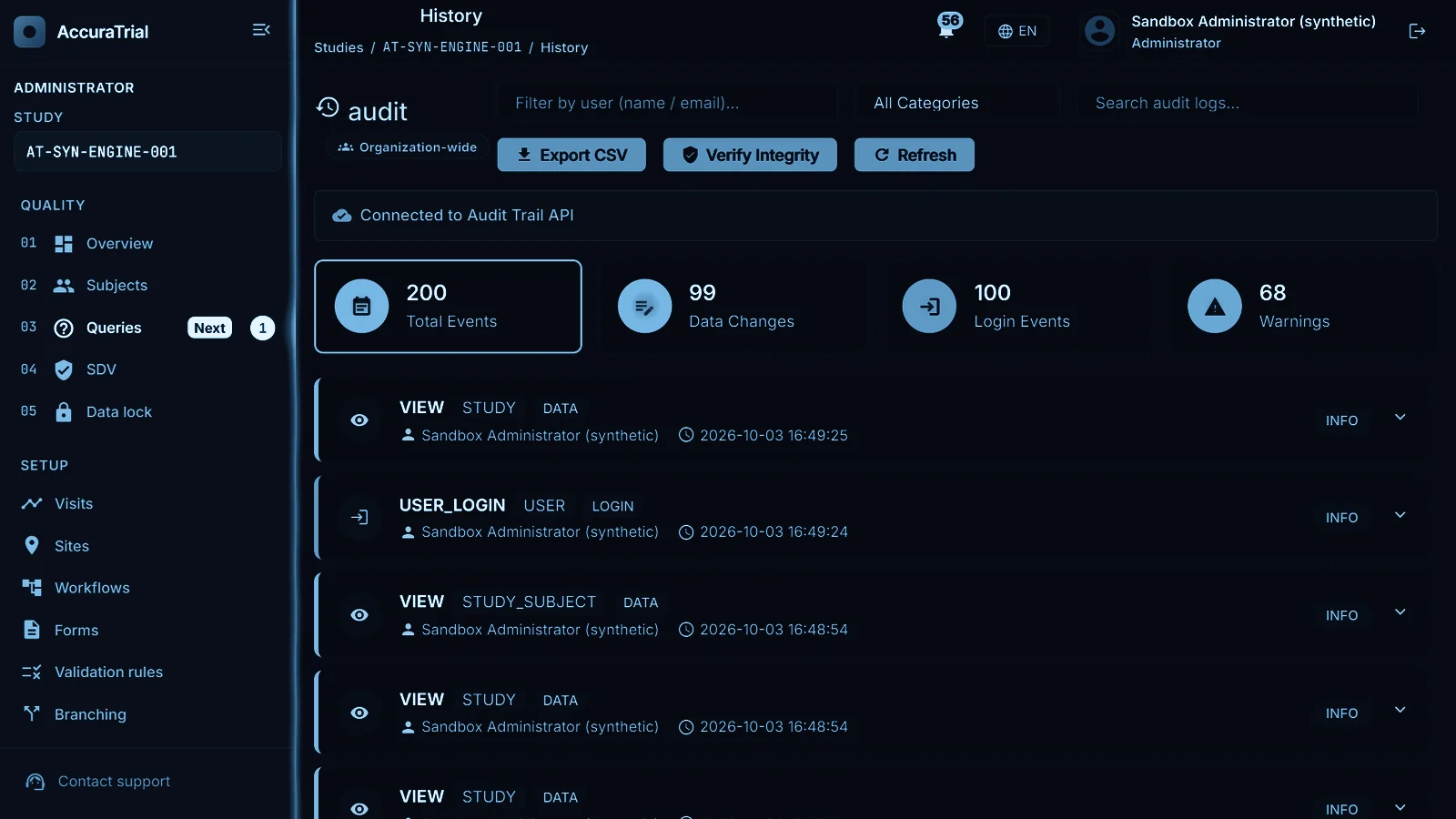
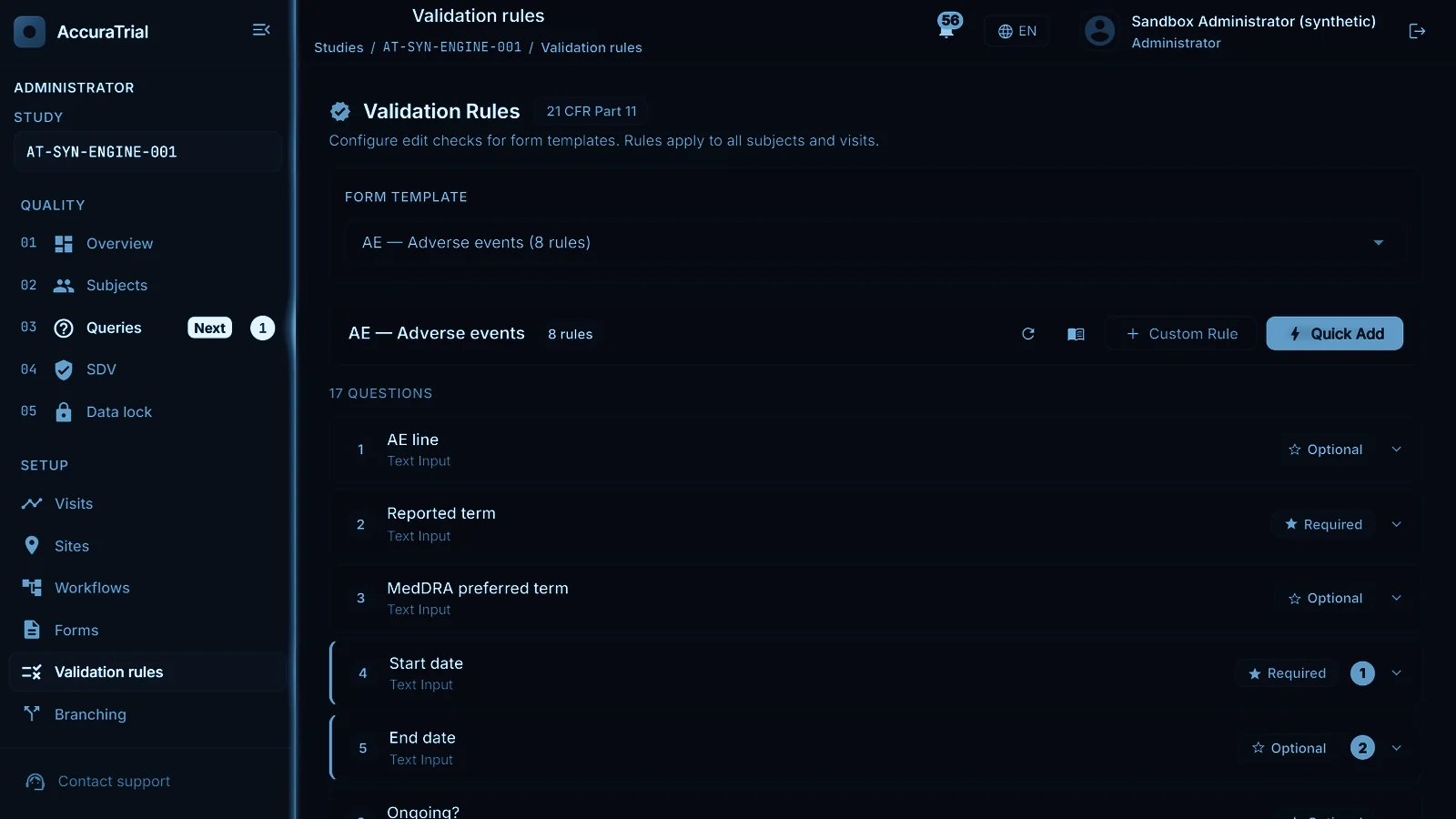
Data capture, edit checks, queries, source data verification, data lock and the audit trail, running on the study ontology.

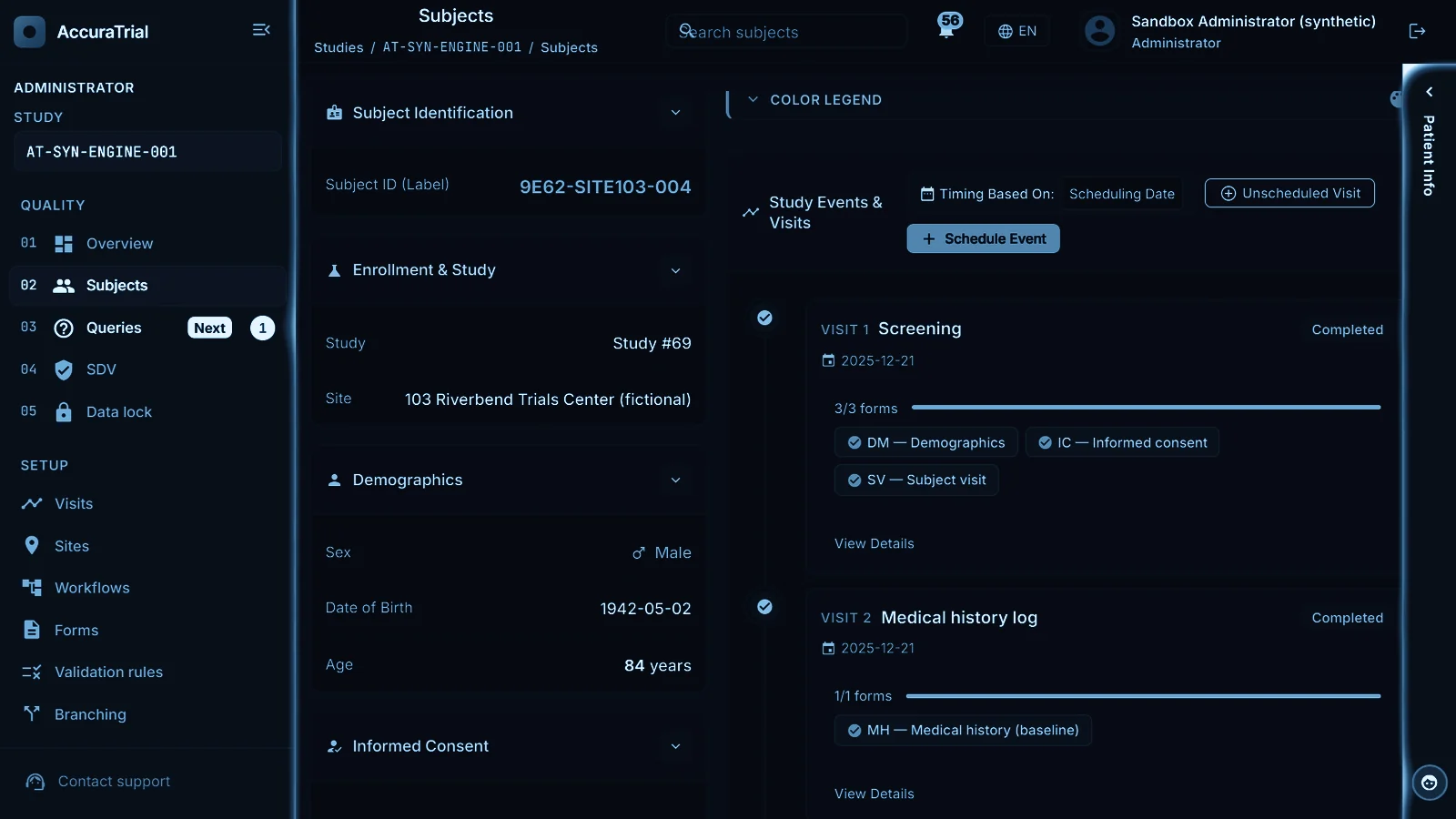
AccuraTrials EDC subject view: visits on a timeline, each with its completed forms, in a synthetic demonstration study.

AI agents

Hand off the busywork.Keep every sign-off.

We’re building agents to draft, check and trace from that same study ontology. Your team reviews and approves the work.

Agent run

Every step recorded. Every action approved.

  • AuditableInputs, outputs, sources and approvals recorded; the run replays.
  • Source groundedEvery step cites the document, specification or data behind it.
  • Versioned executionAI drafts; approved rules run as versioned, deterministic code.
Reconcile central lab resultsACT-217 · illustrative
  1. Ingest412 results receivedDone
  2. MapMatched to visits and LOINC codesDone
  3. CheckRanges and visit windows3 flagged
  4. Draft3 queries, each citing its ruleDrafted
  5. ApproveData manager sign-offAwaiting

Trust

Built for inspection,not for demos.

EDC controls designed to support the rules your study answers to. Study-specific validation and your own procedures still apply.

  • 21 CFR Part 11Records · signatures
  • ICH E6(R3)Good clinical practice
  • HIPAADesigned to support
  • GDPRDesigned to support

Infrastructure built to the SOC 2 trust principles, with an information security program aligned to ISO 27001. Neither is a completed audit or certification yet.

Who it’s for

Built for the teamsthat run the study.

01

CROs

Every sponsor’s study on one governed ontology, from build to lock.

  • Data managers
  • Project managers
  • Medical coders

02

Sponsors

One definition of each study across programs, vendors and amendments.

  • Clinical operations
  • Data management
  • R&D IT

03

Biotechs

Your first trial, without a long vendor build.

  • Clinical leads
  • Data managers
  • Quality
  1. 01PilotInside one live study
  2. 02Full studyThe whole study on one ontology
  3. 03PortfolioMore studies, same layer

Questions

What teams ask first.

What is the AccuraTrials semantic layer?

The core of the intelligence layer: one shared definition of the study that people, systems and AI agents all read. Arms, visits, activities, forms, items, rules, endpoints and decisions are typed entities with explicit relationships, each linked to the document clause, specification or approval it came from. AccuraTrials calls it Accura OS: AccuraTrials EDC runs on it today, and connectors to central labs, eTMF, CTMS and safety systems are in development.

What is in production today?

AccuraTrials EDC, in production on a paid study: data capture, edit checks, queries, source data verification and data lock, with randomization, ePRO and eConsent built in, audit trails and electronic signatures, mid-study amendments, governed arm decisions and reconciliation. The AI agents for study build, data review, medical coding and amendment impact are in development.

How does AccuraTrials use CDISC USDM and OpenStudyBuilder?

They are the backbone of the ontology. USDM gives the study definition its structure, OpenStudyBuilder is its open-source foundation, and CDASH, SDTM and controlled terminologies such as MedDRA, WHODrug, LOINC and SNOMED CT give each element a standard meaning.

Do we have to replace our EDC or CTMS?

No. AccuraTrials EDC is in production and can run a study end to end, and the semantic layer is designed to sit across the systems you already use. Connectors to other trial systems are in development.

Can we add or change arms while a trial is running?

Yes. A new or changed arm arrives as a reviewed amendment applied to the running study, with every form, check and collected value it touches counted before anyone signs. Stopping, graduating or reopening an arm is a governed decision: proposed, reviewed by a different qualified person and executed with an electronic signature. Participants already enrolled keep their assignments and their data, and the study is not rebuilt.

How does AccuraTrials handle data reconciliation?

Continuously, inside the study rather than in a cleanup sprint before lock. Adverse events are reconciled against safety reporting case by case, with each discrepancy resolved and verified by a second investigator; drug-kit counts are reconciled site by site with signed evidence; and every import is reconciled against its source. Open safety items hold the study’s closeout until they are resolved.

Give your next study one model to run on.

See the EDC in production and the agent workflows we’re building next.

jgui@accuratrials.com

Request a demo · your study, our model

See AccuraTrials in action.

Walk through the EDC in production and the agent workflows we’re building, using a study like yours.

I'm interested in

Tell us about your study. We’ll follow up by email.

We will be in touch.

Your demo request has been received. We’ll follow up by email.